Why We Are Building on Canton
Silvana Book is Live!
Great news here! We’ve just launched Silvana Book – an ultra-fast, private, enterprise-grade orderbook on Canton built for people who trade with real size and real constraints.
We are now live with an Early Bird Program that grants early users exclusive access to features before the wider public launch and rewards them with eligibility and whitelisted status once onboarding and verification are complete.
✅ Pass onboarding, complete KYC, get whitelisted, then purchase an Early Bird ticket to jump on the bandwagon.
What We Bring to the Table
Silvana Book’s core promise is simple: execute matching privately at high speed, settle atomically on-chain, keep custody of your assets, and prove what matters.
Let’s take a close look at the value the order book proposes.
Private Off-Chain Order Matching
Matching occurs within a company’s private environment, entirely offline: orders, depth, balances, and strategies are not publicly visible, reducing information leakage, unintended market effects, third-party arbitrage, and MEV-style interference.
Execution at the Speed of Light
Silvana Book decouples off-chain execution (matching) from the DvP settlement on Canton. Once matching is complete, an optimistic state is generated, and settlement occurs later. That enables ultra-fast execution while preserving on-chain finality and security.
Non-custodial Settlement
No assets are escrowed during matching; they remain in the party’s wallet until the transaction finalizes. If settlement conditions aren’t met, the transaction rolls back, and balances remain unchanged.
Agentic Orderflow
Silvana Book uses off-chain agents that place/cancel bid and ask orders, react to events, create proofs, and execute settlement workflows without details to the public. This allows for a wide range of trading strategies, including market making, arbitrage, scalping, and portfolio rebalancing.
Wallet Model Aligned with CIP-56 Standard
Silvana Book integrates with non-custodial Canton wallets (e.g., Loop) and follows the DvP flow. The docs explicitly note that while DvP is native to Canton, only some wallets currently expose it to users due to the multi-step interaction complexity. We keep on integrating new wallets.
Why Canton?
Traditional finance relies on reconciliation, with each institution maintaining its own records and incurring costs to align them. Public blockchains solve coordination through global transparency, but for institutions, this creates new risks – information leakage, governance limits, and inherited throughput constraints.
These issues are especially a blocker for RWAs, a rapidly growing multi-trillion-dollar market where fragmentation already hinders scalable adoption.
🌈 Canton’s “State of RWA Tokenization 2026” report states tokenized RWAs exceeded $36B (excluding stablecoins) as of late 2025 and highlights measurable inefficiencies from fragmentation, including 1–3% pricing gaps for identical assets and 2–5% friction when moving capital cross-chain.
Canton’s major design pivots that make it fit for large-scale markets include the following:
Built-In Privacy
Business operations like silence. However, blockchain’s key principle is total transparency and visibility.
In Canton, there’s no global state or Mempool. Instead of replicating the entire ledger everywhere, transaction data is segregated so stakeholders (parties) see only what they need and what affects their balances. For the rest, transaction details are not visible.
✅ Transactions are settled privately on-chain.
This is the foundation of its “institutional-grade privacy” posture.
Synchronized Tx Flow
A core premise behind Canton’s approach is that unsynchronized state across institutions creates inefficiency, and the system needs a way to align data and outcomes across trust boundaries. The synchronizer ensures that transactions are aligned across parties and that data is accessible only to them.
Secure Atomic Transactions
Canton’s CIP-56 Standard supports atomic Delivery versus Payment (DvP) transactions, ensuring delivery and payment occur as a single indivisible operation. Both parties sign and execute their parts; if either fails, the transaction rolls back, and assets remain under their control, eliminating contractual risk.
✅ This also means parties retain control of their assets until a transaction is settled.
KYC and Transfer Restrictions
Generic token standards are often permissionless by default. As Digital Asset notes, a simple ERC-20 transfer is unsuitable for RWAs because it imposes no ownership restrictions and does not enforce KYC, falling short of AML/CTF requirements.
Canton addresses this at the contract level through Daml’s authorization and visibility model, using RWA-aligned patterns such as an asset registry acting as a transfer agent, with integration into off-ledger KYC systems and DvP workflows.
Bridgeless Interoperability
RWAs require connectivity – cash legs, collateral legs, registries, custody, and trading venues. The Canton Network design emphasizes native interoperability across subnets without relying on bridges, which have historically been security vulnerabilities.
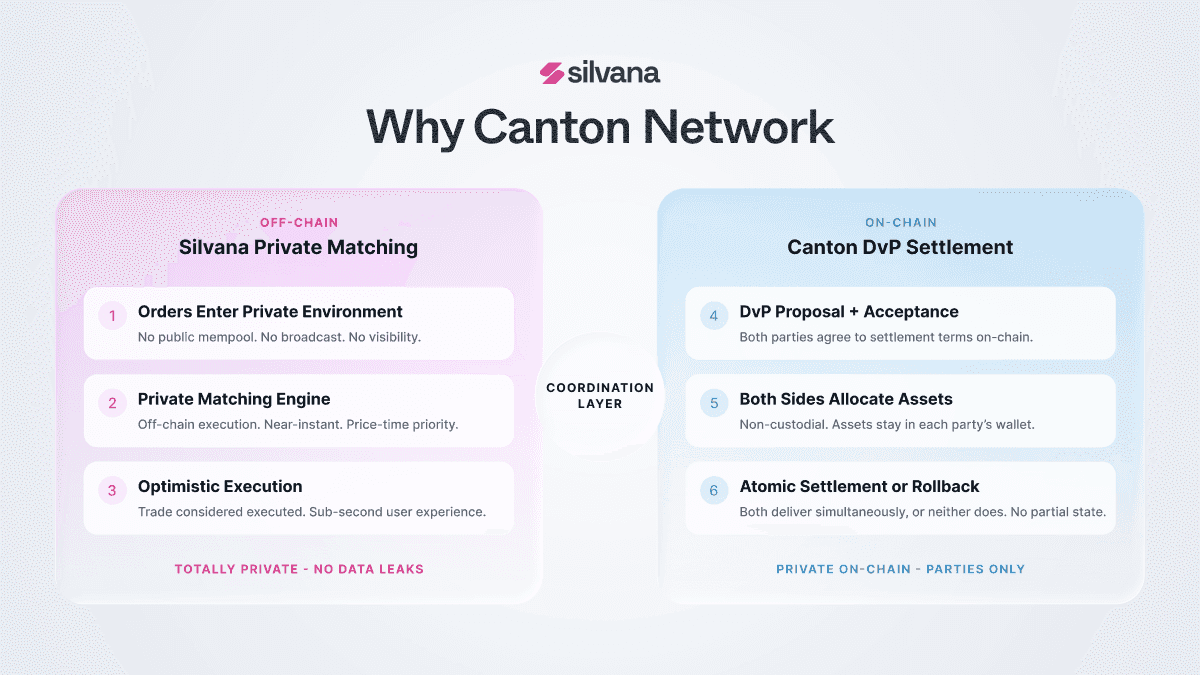
This is what the orderflow looks like with Silvana+Canton:
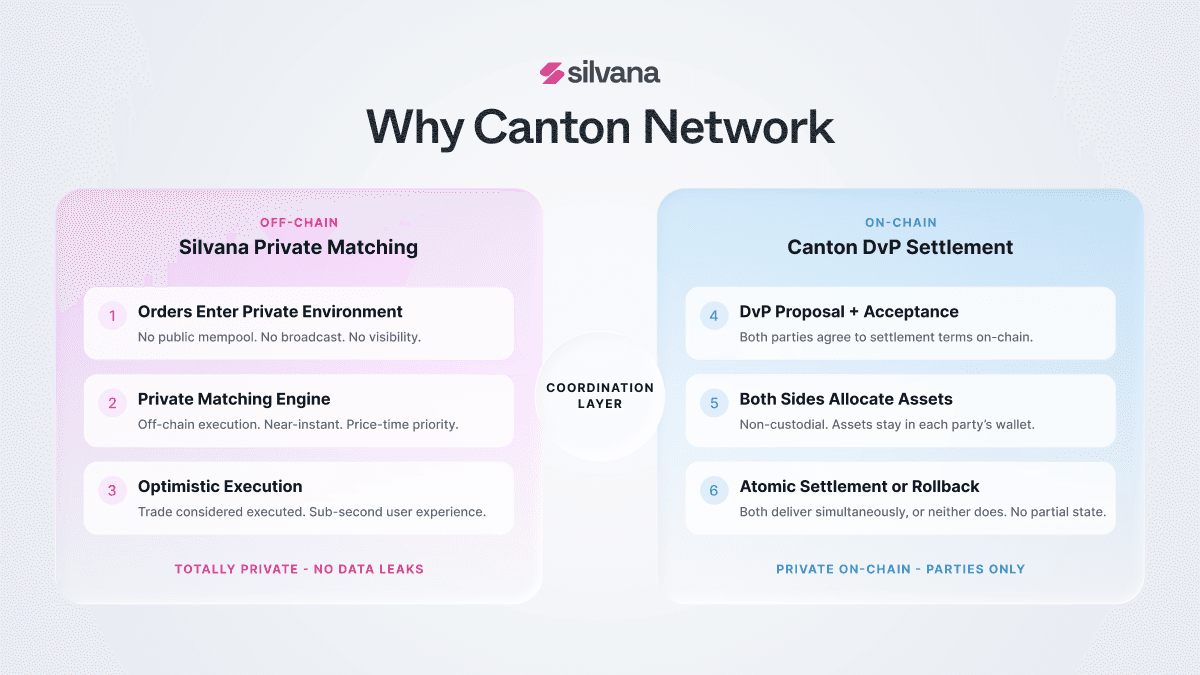
The table below shows how Silvana Book and Canton match to provide users with a great trading experience:
| Silvana Book Feature | User Value | Canton Solution |
|---|---|---|
| Total Privacy Ensured | Private off-chain order matching. | • Settlement domain with privacy expectations and stakeholder-scoped visibility; • Private on-chain settlement. |
| Decoupling Execution from Settlement | • Sub-second “optimistic” execution, settlement catches up. | DvP settlement on-chain for atomic delivery+payment. |
| Non-Custodial Security Arrangements | Assets stay in the wallet until settlement. | • DvP model: settlement occurs only when both sides allocate; • Transactions roll back on failure. |
| Agentic Execution | Agents handle the proposal intake, preconfirmation, DvP execution, settlement. | • Node authentication and DvP workflows; • Global Synchronizer ordering. |
| Permissioning & Compliance Posture | Regulated access via: • KYC; • Whitelisting; • geo controls. | Configurable privacy/permissions and institutional controls, enabled by the DAML language. |